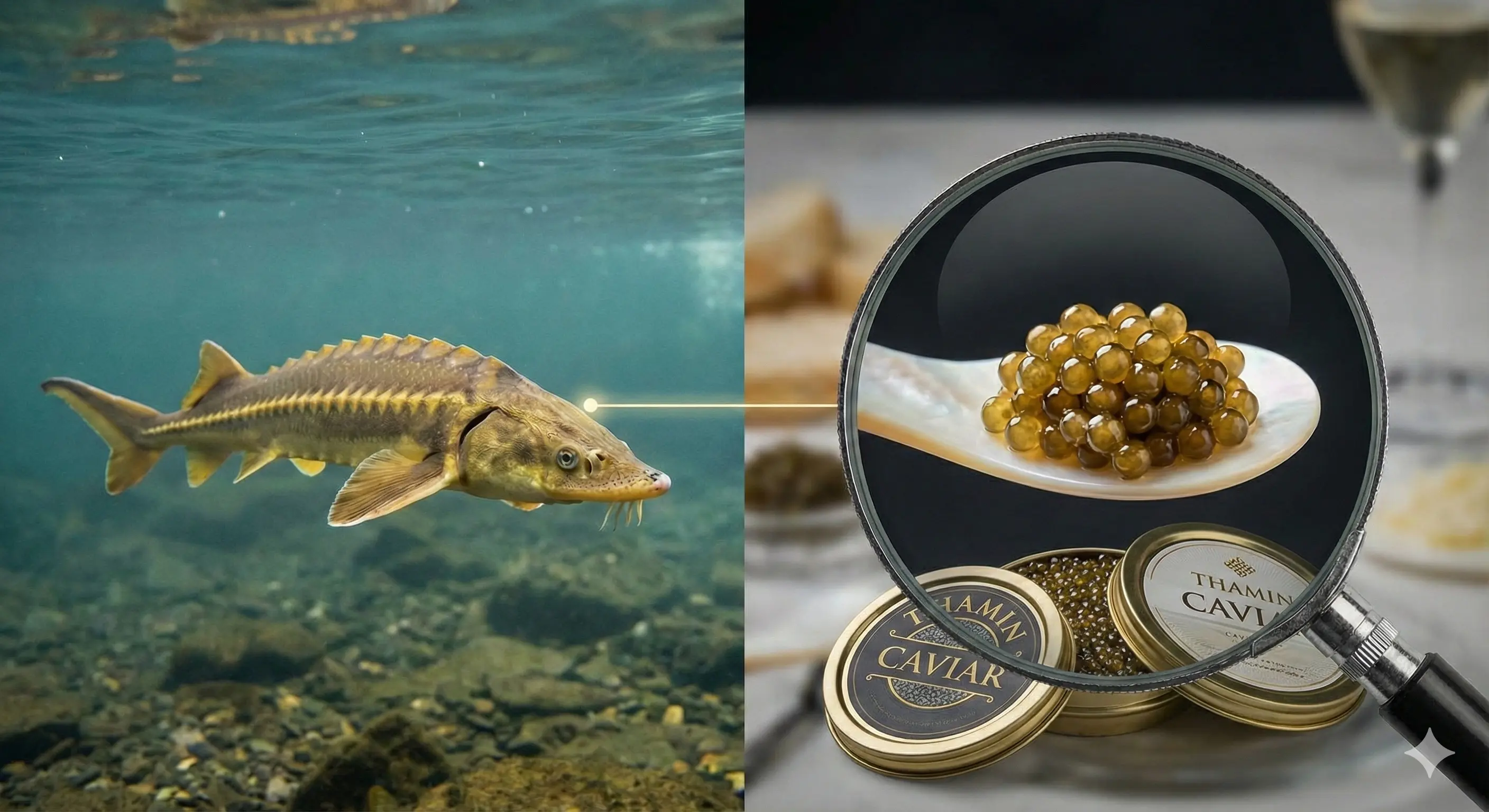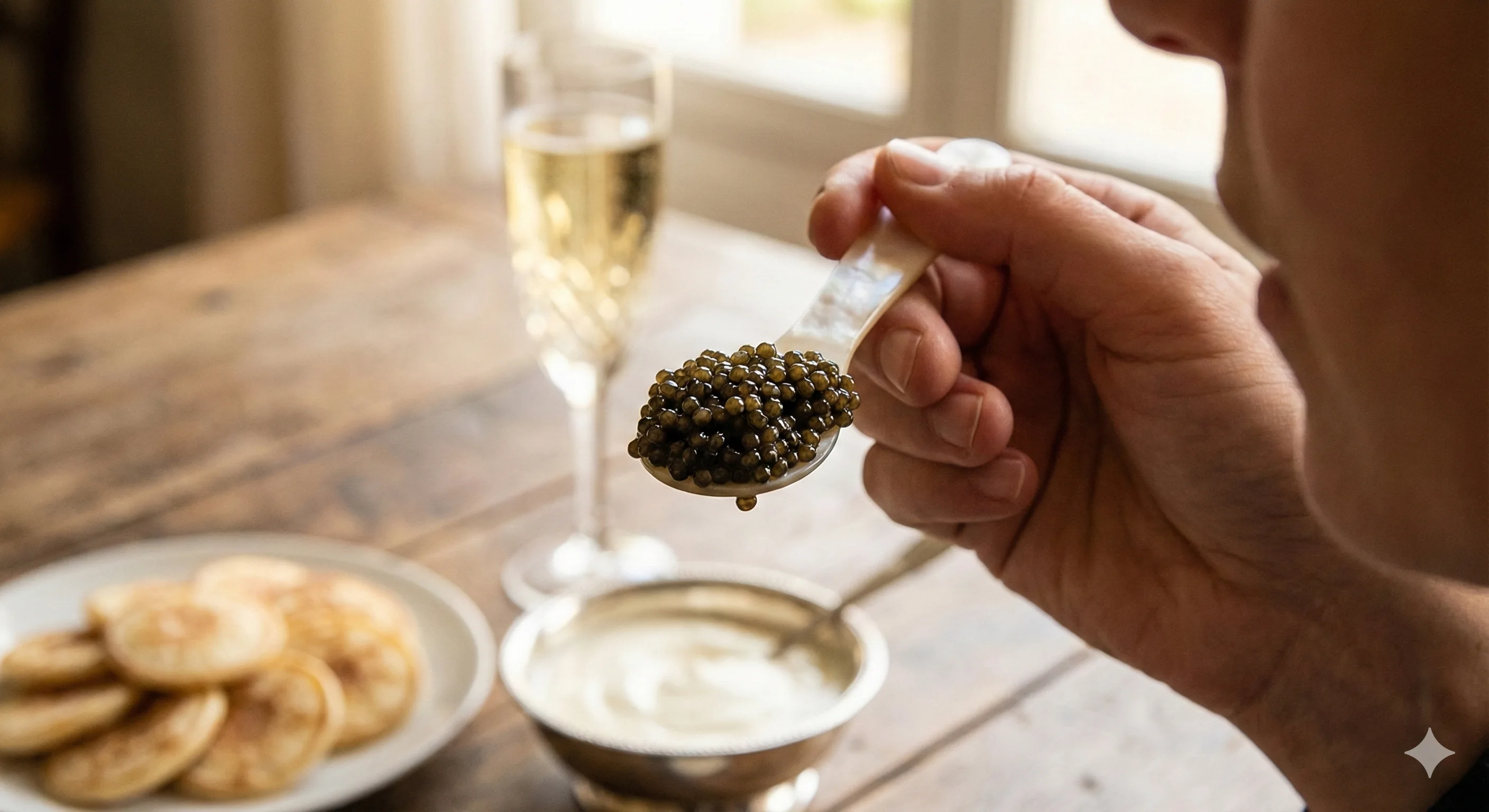
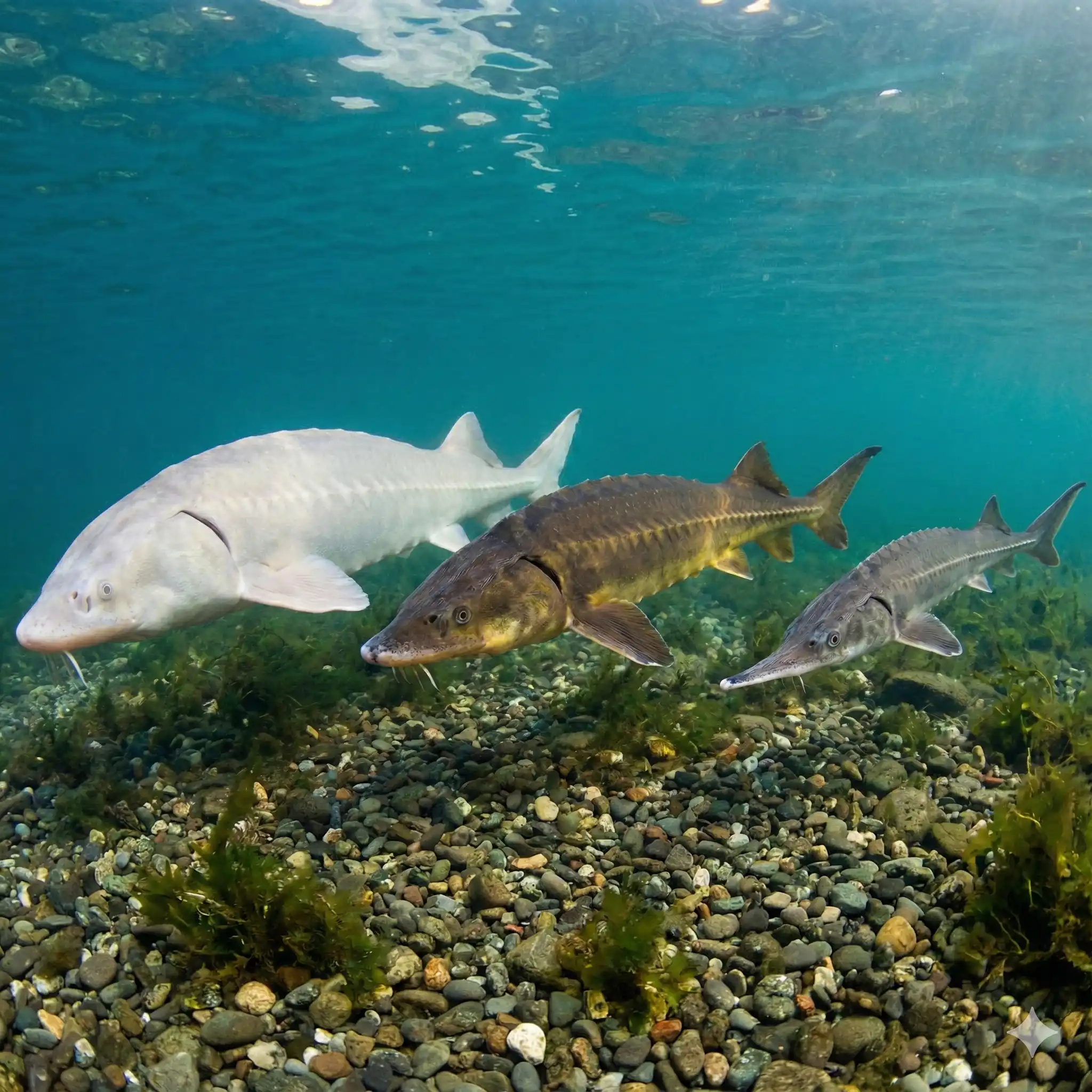
Sturgeons are ancient fish from the family Acipenseridae. They have lived on earth for more than 150–200 million years and today scientists recognise about 25–27 species, all in the Northern Hemisphere.
Some of these sturgeons, such as Beluga, Osetra (Russian and Persian sturgeon), Sevruga, Siberian sturgeon, White sturgeon, Sterlet and the Kaluga–Amur group, are also known because their roe is used to make real caviar. But before we talk about caviar, it helps to understand the fish themselves: where they live, how they grow and why many of them are now endangered.
The most famous sturgeons for caviar, especially Beluga and Iranian Osetra, come from the Caspian Sea region, which has been the natural home of many sturgeon species for centuries.
This article explains the main sturgeon species linked to caviar, their natural regions, size, life cycle and conservation status and (most importantly for buyers) what that biology usually means for the taste, texture, and price of the roe.
What Is a Sturgeon?
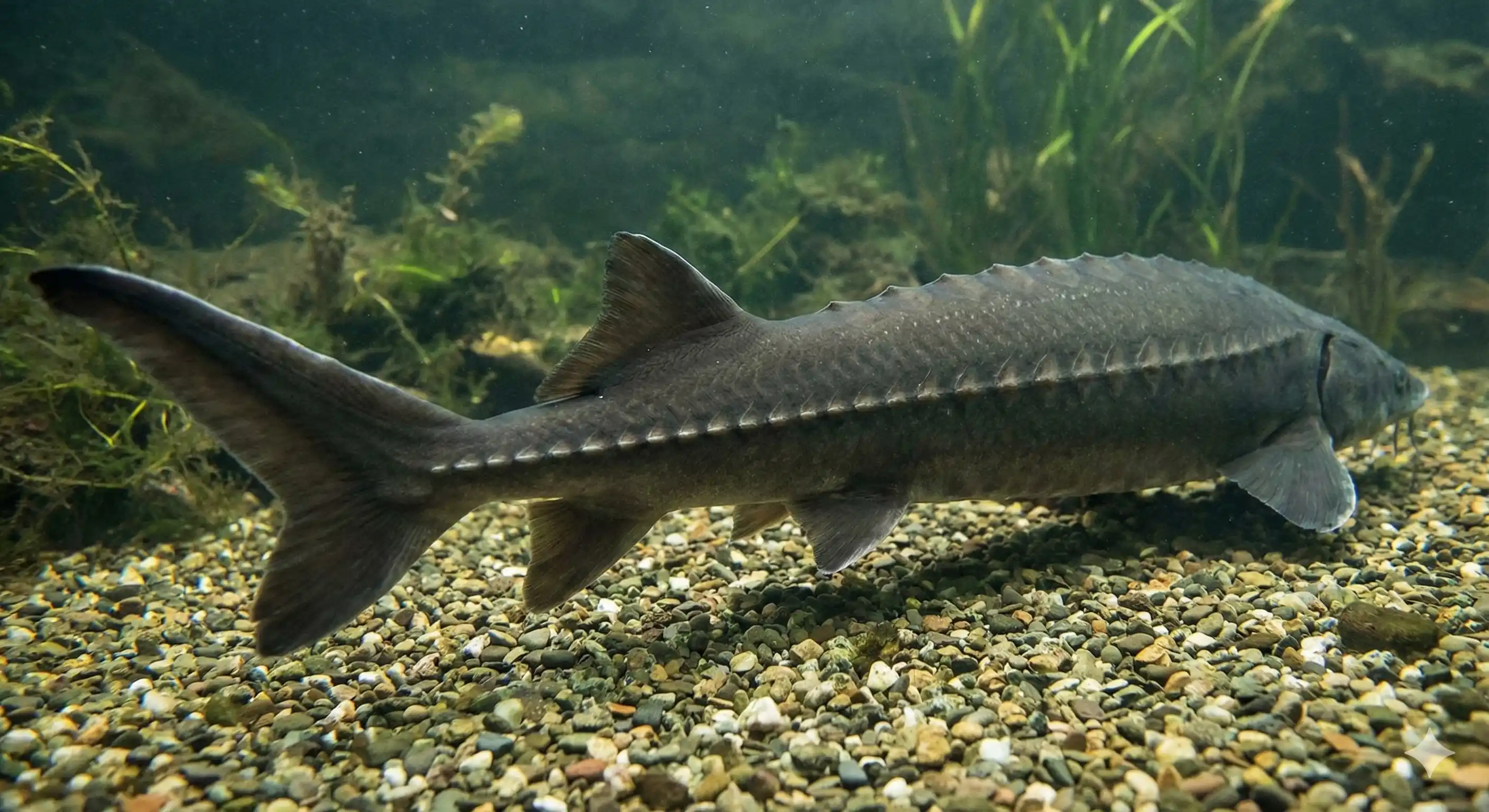
Sturgeons are large, slow-growing fish with a long body, a shark-like tail and five rows of hard bony plates on the skin instead of normal scales. Most species live in coastal seas and swim into rivers to spawn. A few live only in freshwater lakes and rivers.
Many sturgeons can live for several decades. Some Beluga and White sturgeons can reach more than 4 metres in length and live 80–100 years. Because they grow slowly and reproduce late, their numbers can fall quickly when rivers are blocked or when fishing pressure is too high.
Why the Species Matters to Caviar Taste (Not Just to Scientists)
Two sturgeons can look similar, but their roe can taste totally different. The main reasons are simple:
- Maturity time: fish that take 15–20 years to mature (like Beluga) cost more because the farm waits longer.
- Fat vs minerals: higher fat tends to taste more buttery and soft; higher mineral/brine character tastes more crisp and “ocean-forward.”
- Egg structure: some species give a soft “melt”, others give a firmer “pop”.
So yes, sturgeon biology is buyer information. It explains why one tin feels like cream and another hits like sea salt and minerals.
Main Sturgeon Families
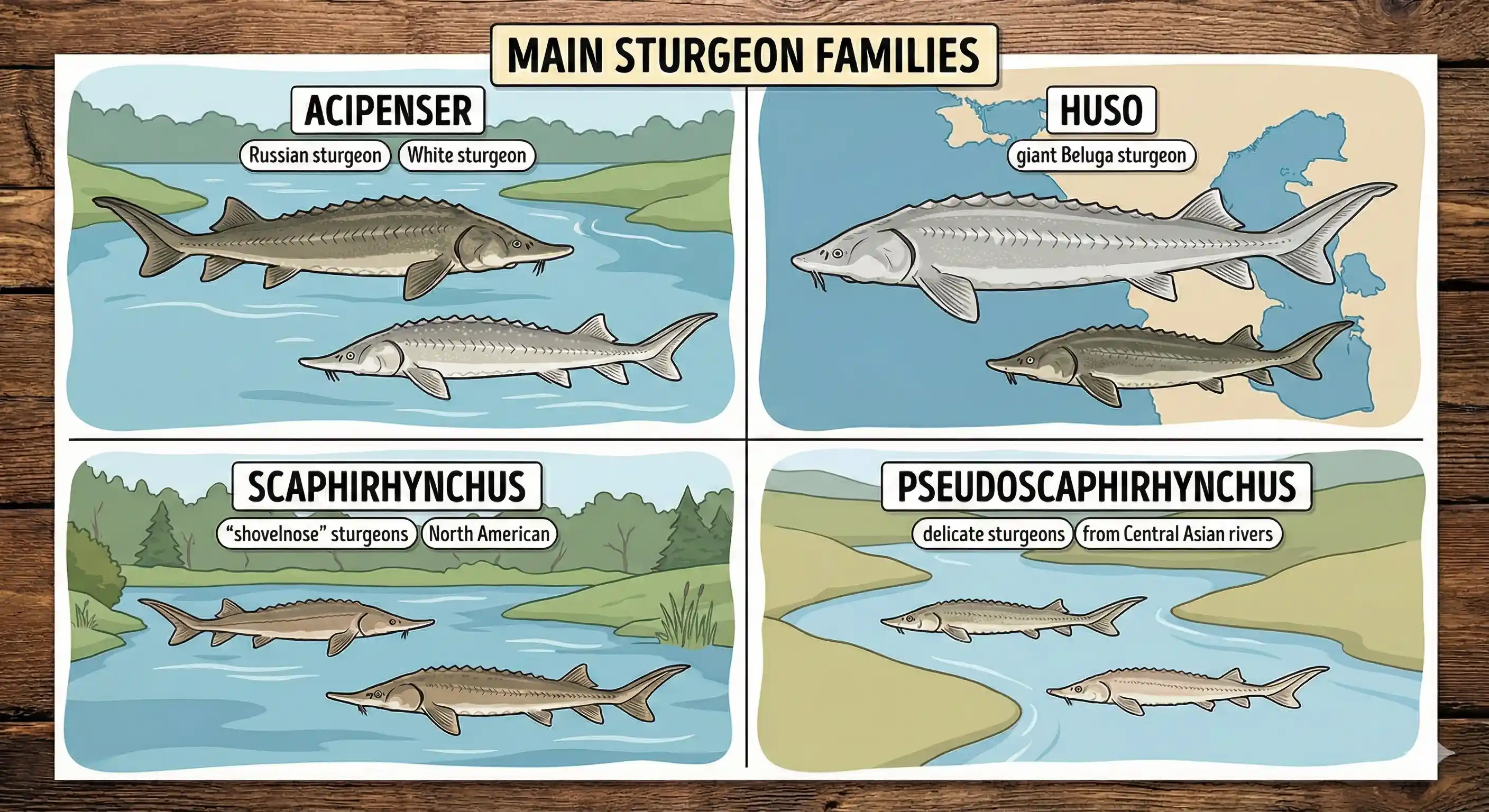
All sturgeons belong to the same family, but scientists group them into four main branches (genera). These groups help classify where each species sits on the sturgeon family tree.
- Acipenser: the largest group. It includes Russian and Persian sturgeon (Osetra), Siberian sturgeon, White sturgeon, Atlantic sturgeon, Lake sturgeon, Sterlet and many more.
- Huso: only two giant species: Beluga sturgeon in the Caspian and Black Sea region, and Kaluga sturgeon in the Amur River basin in East Asia.
- Scaphirhynchus: small “shovelnose” sturgeons from North American rivers such as the Mississippi and Missouri.
- Pseudoscaphirhynchus: very small and very rare sturgeons from Central Asian rivers such as the Amu Darya and Syr Darya.
Only some of these species are used for caviar, but all of them play a role in their local river and sea ecosystems.
Main Sturgeon Species Linked to Caviar
The species below are best known because their roe is traditionally used for caviar. This section keeps the focus on the fish (region, growth, status) and adds the buyer-friendly part: what the roe typically feels like and why it is priced the way it is.
Beluga Sturgeon – Huso huso
Beluga is the largest sturgeon in the world. It lives in the Caspian and Black Sea basins and swims up large rivers such as the Volga and Ural to spawn. Females need many years to reach maturity, often more than 15–20 years.
What that means for caviar: you are paying for time. Beluga roe is famous for large grey pearls and a soft “melt”. The taste is usually mild, creamy and buttery, which is why beginners love it and why it sits at the top of the market.
Because of heavy fishing and dam construction in the 20th century, wild Beluga numbers dropped sharply. Today the species is listed as critically endangered, and almost all legal Beluga products come from controlled farms.
Osetra / Russian Sturgeon – Acipenser gueldenstaedtii
Russian sturgeon is native to the Caspian, Black and Azov Seas and their rivers. It is a medium-sized sturgeon that can reach around 2 metres in length. In the past it was one of the most important commercial sturgeons in the Caspian region.
What that means for caviar: Osetra is the “chef’s choice” because it tends to have a firmer pop than Beluga and a richer, nutty finish. Colour can range from golden to deep brown, and price usually sits below true Beluga but above entry farmed types.
Wild populations declined strongly and are now under protection. Today most “Osetra” products come from Russian sturgeon raised in farms in Europe, the Middle East and Asia.
Persian Sturgeon – Acipenser persicus
Persian sturgeon is very close to Russian sturgeon and is found mainly in the southern Caspian Sea and rivers flowing from Iran and neighbouring countries. It has a similar body shape and size and was historically fished heavily for its roe.
What that means for caviar: buyers usually expect an Osetra-style experience: medium pearls, a clean pop, and a deeper, more complex finish than mild Beluga. Many people also look for it for heritage reasons connected to the Caspian tradition.
Many farms in the region now work with Persian sturgeon under strict rules to reduce pressure on wild stocks and support the image of Iranian caviar.
Sevruga – Stellate Sturgeon, Acipenser stellatus
Stellate sturgeon is a slim fish with a long pointed snout and star-shaped bony plates along its back, which is why it is sometimes called “starry sturgeon”. It lives in the Caspian and Black Sea region and uses large rivers for spawning.
What that means for caviar: smaller eggs, more intensity. Sevruga is typically brinier and more mineral-forward, with a sharper “ocean punch”. It is for people who actually like strong seafood character.
Because it matures earlier than Beluga and Russian sturgeon, it was once very common in fisheries. Today, however, it is also critically endangered and protected, and farming has become the main source.
Siberian Sturgeon – Acipenser baerii
Siberian sturgeon comes from river systems across Siberia, including the Ob, Yenisei and Lena. It is smaller than Beluga but still a large fish, often reaching around 1.5–2 metres.
What that means for caviar: Siberian sturgeon generally matures faster (often around 5–7 years in farming), which helps make it more affordable. The roe tends to be smaller and darker with a more savoury, slightly earthy finish compared to creamy Beluga.
The species adapts well to controlled conditions and is now one of the most common sturgeons in farms. This makes it an important “workhorse” for producers and reduces pressure on more fragile wild species.
Sterlet – Acipenser ruthenus
Sterlet is a smaller freshwater sturgeon found in the Danube, Volga and other rivers that flow into the Caspian, Black and Baltic Seas. Adults are usually under 1 metre long.
What that means for caviar: sterlet roe is often used in breeding programs and hybrids. You may see it as part of cross-breeding projects rather than as a mainstream “classic trio” caviar.
In the past Sterlet was served in royal courts and monasteries, often smoked or cooked whole. Today it is important both for conservation projects and for breeding programmes that create hybrids.
Kaluga Sturgeon – Huso dauricus
Kaluga is a giant predatory sturgeon from the Amur River system between Russia and China. It can reach lengths close to Beluga and feeds on other fish in the river and estuary.
Buyer warning (read this twice): “River Beluga” is a marketing term often used for Kaluga. Kaluga can be excellent, buttery and large-pearled, but it is not true Caspian Beluga (Huso huso). If you care about authenticity, the only honest proof is the species code on the label (see the CITES section below).
Heavy fishing in the 20th century led to a strong decline in wild Kaluga numbers. Modern production focuses on farmed Kaluga and on hybrids with Amur sturgeon.
Amur Sturgeon – Acipenser schrenckii
Amur sturgeon is a true sturgeon from the same river system as Kaluga. It is smaller but still a large fish and shares part of its life cycle with Kaluga in the Amur and its tributaries.
What that means for caviar: Amur is frequently used in farming and in hybrids because it adapts well and can help create consistent, stable supply. Hybrids often aim for “Beluga-like” size with a firmer pop.
Many farms use Amur sturgeon together with Kaluga to create hybrids that grow faster and adapt well to ponds and tanks.
White Sturgeon – Acipenser transmontanus
White sturgeon lives on the Pacific coast of North America and in rivers such as the Sacramento, Columbia and Fraser. It is the largest freshwater fish in this region and can live for many decades.
What that means for caviar: white sturgeon roe is popular because it is clean, structured and reliable, often with a smooth brine and medium-large pearls. It is widely farmed, which means consistent availability and pricing compared to rarer Caspian heritage species.
Pollution, dams and historical overfishing reduced many local populations, but strong protection and hatchery programmes now support recovery. Farmed White sturgeon is widely used for both meat and roe.
All of these species are part of the core group of sturgeons that people usually mean when they talk about “caviar fish”.
Simple Table of Important Sturgeon Species
This table gives a quick view of where the main sturgeon species live, how big they are and their general conservation status.
| Name | Scientific name | Main region | Typical size | Status |
|---|---|---|---|---|
| Beluga | Huso huso | Caspian & Black Sea | Up to 4 m or more | Critically endangered |
| Russian sturgeon (Osetra) | Acipenser gueldenstaedtii | Caspian, Black & Azov Seas | Up to around 2 m | Endangered |
| Persian sturgeon | Acipenser persicus | Southern Caspian Sea | Similar to Russian sturgeon | Endangered |
| Sevruga (Stellate) | Acipenser stellatus | Caspian & Black Seas | Usually up to 1.5–2 m | Critically endangered |
| Siberian sturgeon | Acipenser baerii | Siberian rivers | Around 1.5–2 m | At risk in the wild, widely farmed |
| Sterlet | Acipenser ruthenus | Danube, Volga and other rivers | Usually under 1 m | Vulnerable |
| Kaluga | Huso dauricus | Amur River basin | Up to 4 m | Endangered |
| Amur sturgeon | Acipenser schrenckii | Amur River basin | Around 1.5–2 m | Endangered |
| White sturgeon | Acipenser transmontanus | Pacific coast of North America | Up to 3 m or more | Near threatened, protected in many areas |
Readers can use this table to see quickly how each species differs in region, size and level of protection.
How to Identify the Fish on Your Tin (The CITES Code)
You don’t need a lab test to know which sturgeon you are eating. Turn your tin over and check the bottom label. Every legal caviar product should carry a CITES code. The code format can vary by country and brand, but the species identifier is the key.
In plain English: the first three letters tell you the species. This is the simplest way to confirm you are not paying Beluga money for a different fish.
| Code | Common Name | What to Expect |
|---|---|---|
| HUS | Beluga (Huso huso) | The classic “King”. Large grey pearls, mild buttery melt. |
| GUE | Osetra / Russian sturgeon (A. gueldenstaedtii) | Nutty finish, firmer pop, golden to brown colour range. |
| BAE | Siberian (A. baerii) | Darker smaller pearls, savoury/earthy, strong value option. |
| DAU / SCH | Kaluga / Amur group | Often big eggs and “Beluga-like” style, usually firmer pop. |
| DAU × SCH | Kaluga Hybrid | Large distinct eggs, similar to Beluga but typically firmer and more structured. |
Important buyer warning: “River Beluga” is commonly used for Kaluga. If you want true Beluga, look for HUS on the code. No HUS, no true Beluga.
Other Sturgeon Species
Many other sturgeons are rarely used for caviar but are important for nature and local history.
- Atlantic sturgeon – Acipenser oxyrinchus: once common in the North Atlantic and rivers such as the Hudson and St. Lawrence; now protected in many countries.
- Lake sturgeon – Acipenser fulvescens: freshwater species from the Great Lakes and large North American rivers; important for local communities and traditional fisheries.
- Green sturgeon – Acipenser medirostris: found along the Pacific coast; considered threatened.
- Shortnose sturgeon – Acipenser brevirostrum: a small Atlantic species; focus today is almost only on conservation.
- Shovelnose and Pallid sturgeons – Scaphirhynchus spp.: small river sturgeons from the Mississippi and Missouri systems; some populations are critically endangered.
- Central Asian dwarf sturgeons – Pseudoscaphirhynchus spp.: tiny species from the Amu Darya and Syr Darya rivers; several are close to extinction in the wild.
These species remind us that the sturgeon family is wide and fragile, and that protection work goes far beyond caviar farms.
Why Sturgeon Species Matter for Caviar
Knowing the sturgeon behind the caviar helps buyers and chefs understand what they are supporting. A label that lists the species shows:
- which river or sea system the fish originally comes from,
- whether the species is highly threatened or in a better condition,
- and whether the product is from wild fishing (rare and often restricted) or from modern farms.
In this way, learning about sturgeons is not only a biology lesson. It is also part of choosing responsible, sustainable caviar in the future and avoiding misleading labels by using the CITES code as your truth check.